Welcome to my collection of decluttering and feng shui examples and ideas!
My Intention:
To provide a few laughs and to inspire others to make their living space more supportive and pleasing.
To declutter is to "remove unnecessary items from (an untidy or overcrowded place)." -Oxford Languages
"Proper feng shui is purposefully arranging the stuff around you to gain positive results."
-Move Your Stuff, Change Your Life (p.21) by Karen Rauch Carter
Karen Rauch Carter[1] is a professional feng shui consultant and author, and many of my ideas are based on her teachings.
MENU
Click to expand or collapse the menu you want, then click on a keyword or name to go to that section. Or just scroll!
Look for bold print in the narratives to emphasize negative symbolism and things that can work against us.
Keep an eye out for overlap among all of the categories, which are in no particular order.

For those interested in seeing how Sesame helped along the way, here are links to those sections:
Sesame and the Very Long Paper Sort
WHAT NOT TO DO:
Keep things that you only "MIGHT" need or use someday, especially in mass quantities.
Exceptions might be: Keeping a small amount or keeping individual items that are infrequently used but crucial when needed (e.g., special tools).
EXAMPLE 1: THE TWIST TIES
Somehow, I accumulated a ton of twisty ties. I'd see them and think: "What if I need that shape or size? They're only taking up a small bag! I like that color!" But after having to dig through the clump every time I needed one, I decided to downsize. This was more about inconvenience and annoyance as opposed to the items taking up a lot of space. Also, consider the idea of being jumbled or "tangled up" inside. Not good.
BEFORE

DURING

AFTER

Note on Special Tools:
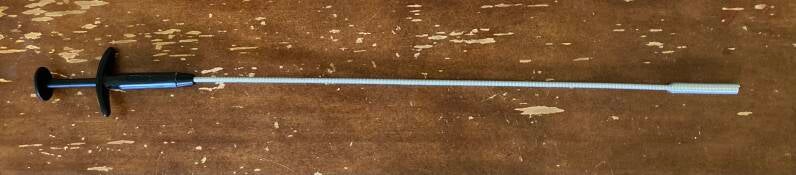
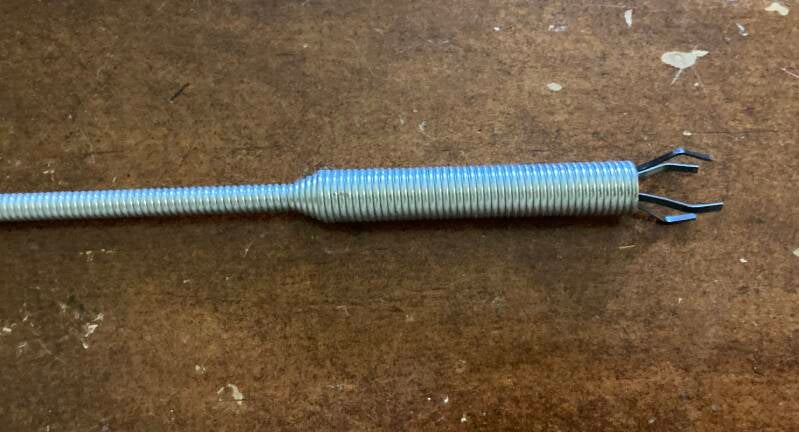
Here's an example of something I use only about 2-3 times a year but find invaluable! I call it "the grabber." I've used it to get out-of-reach cat toys, to thread a power cord out from behind my huge work station, and to unclog a drain. Sesame also thinks it's fun to play with since it's flexible. Luckily, it doesn't take up too much space.
EXAMPLE 2: THE VASES
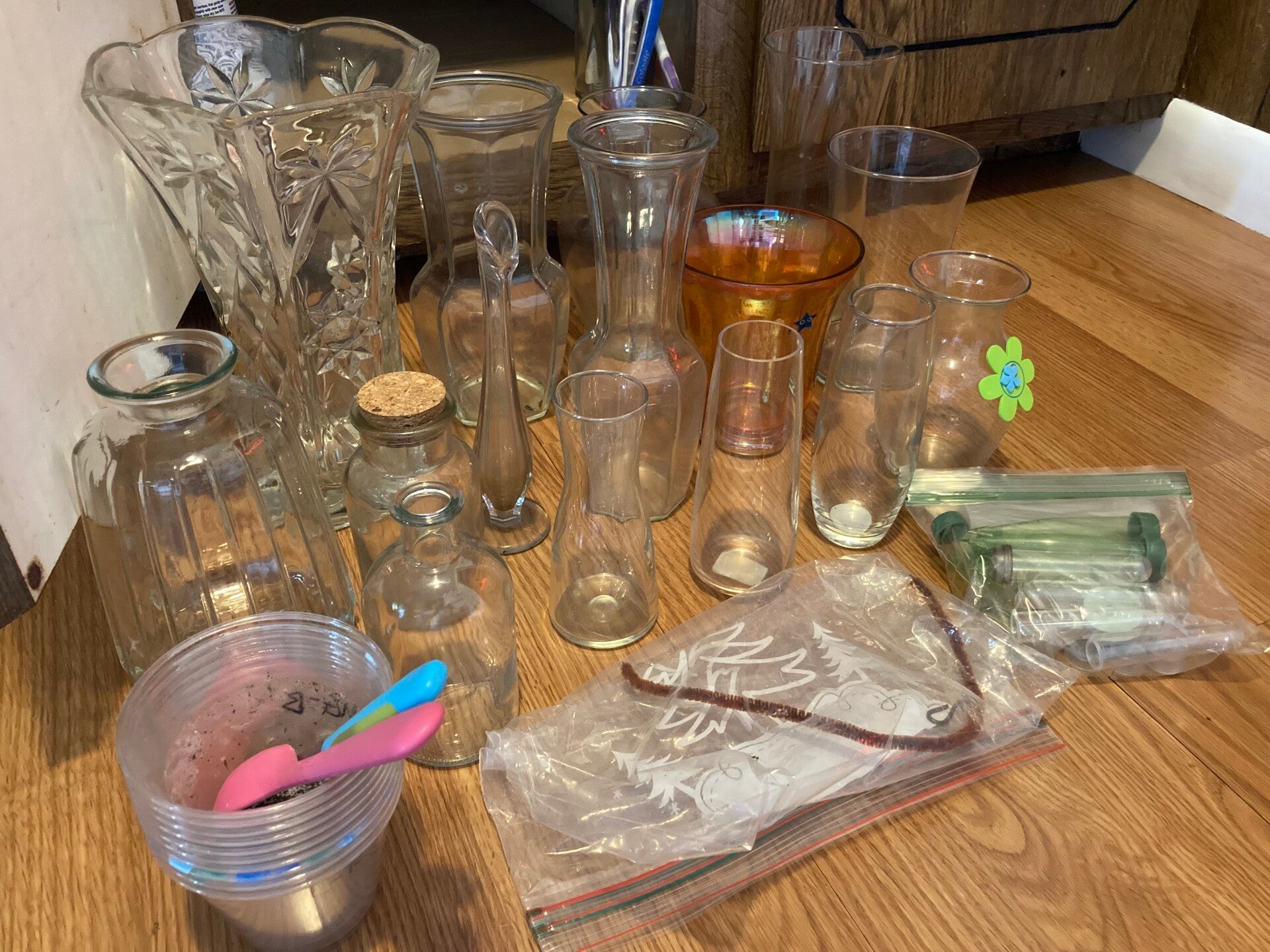
Speaking of mass quantities, one of the projects on my decluttering list was "under the kitchen sink" where I store a few cleaning supplies plus my flower vases. One day, I decided to weed some out (heh) and started removing them. As they kept adding up, I felt extremely overwhelmed* and decided to deal with half of them at that time. I tackled the second half a few weeks later. Final count was about 30 vases! I kept my favorites (about 7 small ones and 5 big ones) and donated the rest. After that, I had room to better organize what was there, and I feel relieved every time I can easily find something without having to move or reach around things that were precariously stacked (and glass, at that). Not to mention that per Karen[1], space = opportunity!
Note: I recall hearing about and reading in Karen's work about the "law of use." My understanding is that not using things can lead to energy being stuck or stagnant. In this example, I wasn't heeding that law when I let most of my vases sit unused for years. It wasn't hurting me but was possibly preventing better energy from flowing properly.
*When decluttering, remember you can break tasks down to prevent becoming overwhelmed and to minimize the temporary mess.

First Half
Second Half

EXAMPLES 3 and 4: THE STAPLES, THE RULERS
With these items, I knew I would consistently use them but realized I don't need the overboard extras and duplicates. Will I be likely to use 5,000 staples in the course of my lifetime? No. Do I need two exact same rulers? Well, yes when M used to steal mine. But that stopped, so no, I don't need two rulers. I kept a portion of the staples plus one ruler and donated the rest. Granted, they didn't take up much space, but why keep them when they would sit unused? More basic principles here.


EXAMPLE 5: THE TOOTHBRUSHES
I keep old toothbrushes because they come in handy for cleaning and other specialty projects. Trouble is that they tend to accumulate since we’re supposed to replace them every “x” months.
The toothbrushes were stashed in a plastic dishpan under our bathroom sink pipes that used to leak (which has since been solved without a plumber, yay!). Total count was 13, and that did not include at least 4 that I keep under the kitchen sink for the same purpose. I picked out various brush sizes, bristle types, and the least dirty ones. The rest will hopefully be donated for environmentally friendly processing.

EXAMPLE 6: THE RUBBER BANDS
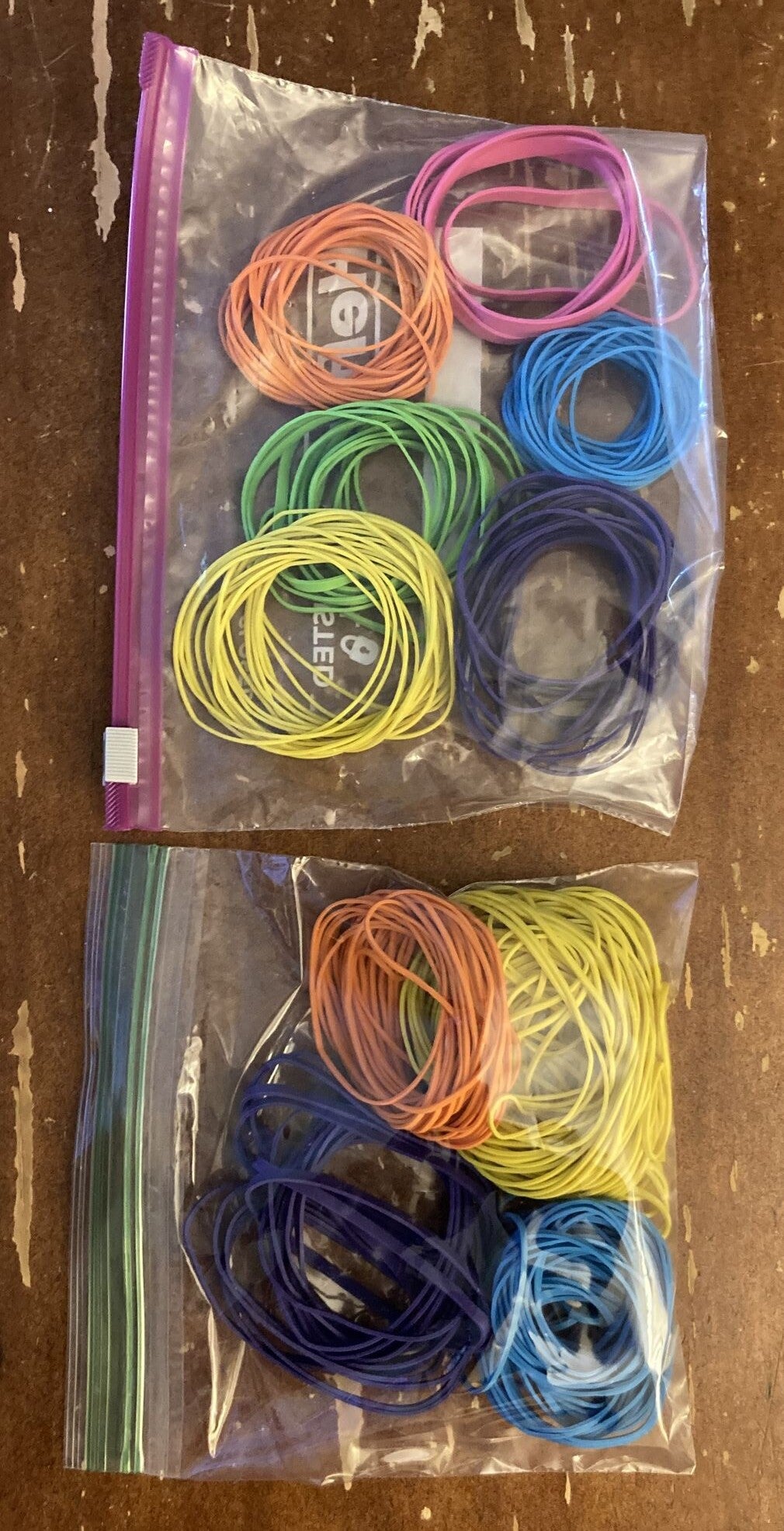
Similar to the twisty ties, this is an example of things that can be difficult to extract if they're stored a certain way. I had a bag of old, random rubber bands that I had accumulated over the years from various sources (e.g., Newspaper adds, flyers, and brochures left left on or thrown at my front door). I think I took a photo of it, but I can't find it. The previous bands were that ugly beige-ish color, and they usually broke when I used them. As a gift to myself, I bought a bag of new, colorful rubber bands in assorted sizes. Unfortunately, the smallest amount I could find was 1/4 lb which amounted to about 325 bands (yes, I counted them!!). I sorted the colors, decided how many of each to keep, and donated the rest.


EXAMPLE 7: THE HANGERS
I love these Ikea wooden clothes hangers! However, it occurred to me that I didn't need 15 unused hangers in addition to the ones that were currently in my closet (which is about 20). I think Sesame was supportive of downsizing. This was another example of stagnation and was also preventing someone else from making use of them. They have now found new homes.

EXAMPLE 8: THE LIDS
Granted, these plastic shoebox lids are not in "mass quantity", but they provide an example of keeping things that are missing parts or otherwise useless. I believe I bought the blue and pink ones right after high school (about 30 years ago!). The containers that go with them have since disappeared. I recycled what I could and tossed the rest.

WHAT NOT TO DO:
Keep (or keep using) things that are broken, dangerous, or in disrepair.
EXAMPLE 1: THE COLANDER
Broken, weak, unstable, sharp edges... Enough said?

"But it's Pampered Chef!"
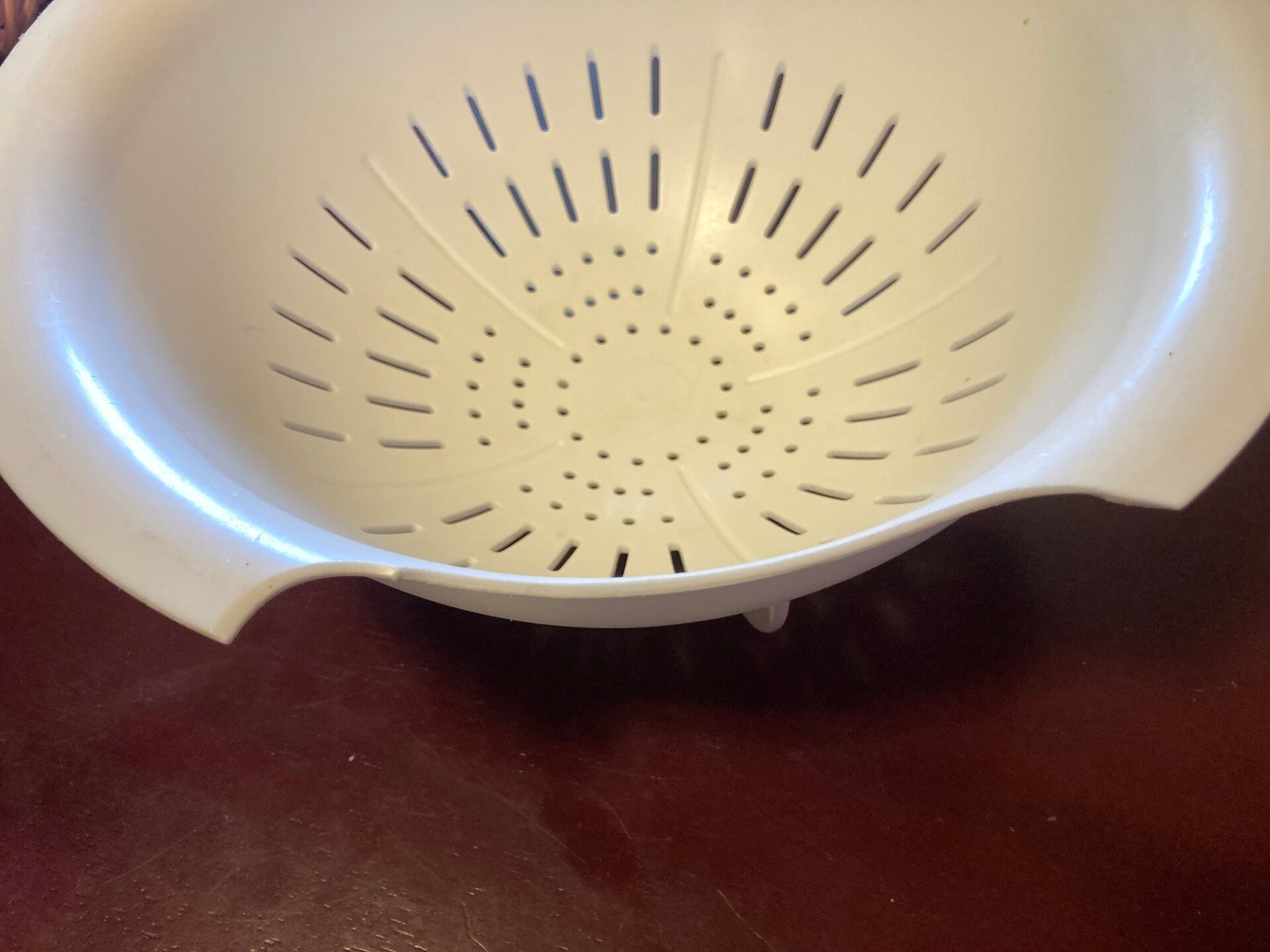
"Get rid of it before someone gets hurt!"
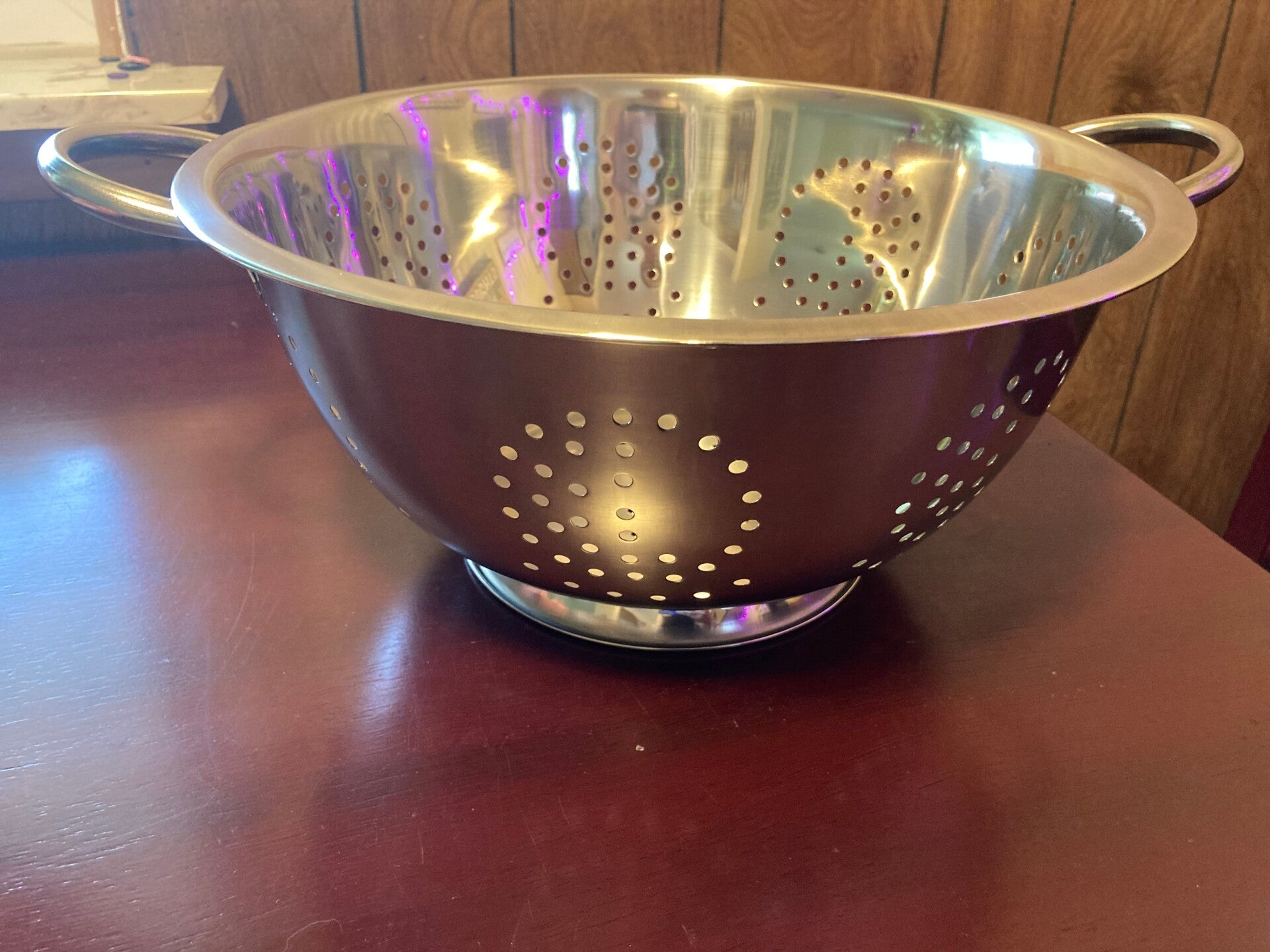
Shiny new replacement ("I love it!").

NOTES:
- Please fix or get rid of broken and dangerous things ASAP whenever possible, first for safety, and second to avoid the negative vibration.
- Notice how the tape started to peel... To me, that was another thing that wasn't functioning properly.
- If you refer to something that has the word “death" in it, that’s probably a hint that something needs to change.
- Although the color red can be used as a feng shui "cure" (see the bathroom sink example), my intention with the tape was to warn versus to stop or start energy. Even if I tried using it as a cure, it wouldn't have stopped the drawer from falling.
EXAMPLE 2: THE DRAWER OF DEATH
This drawer was seemingly stuck shut and remained unused for the first 13 years after moving in to our home (2006).
My dad helped get it operating around 2019, but it would fall off the tracks if pulled out too far. Despite the fear of broken toes or worse, I named it the “Drawer of Death," and we continued to use it to hold kitchen utensils (really poor judgment, I admit).
M’s friends often came over to bake things, so I added a red “x” with tape to remind them to use the drawer with caution.
I added a smiley face to the tape at some point but can’t recall why... Probably denial or maybe just because I like smiley faces.
In late 2024, I finally tracked down our handyman who easily fixed the drawer. Thankfully, no one was hurt.
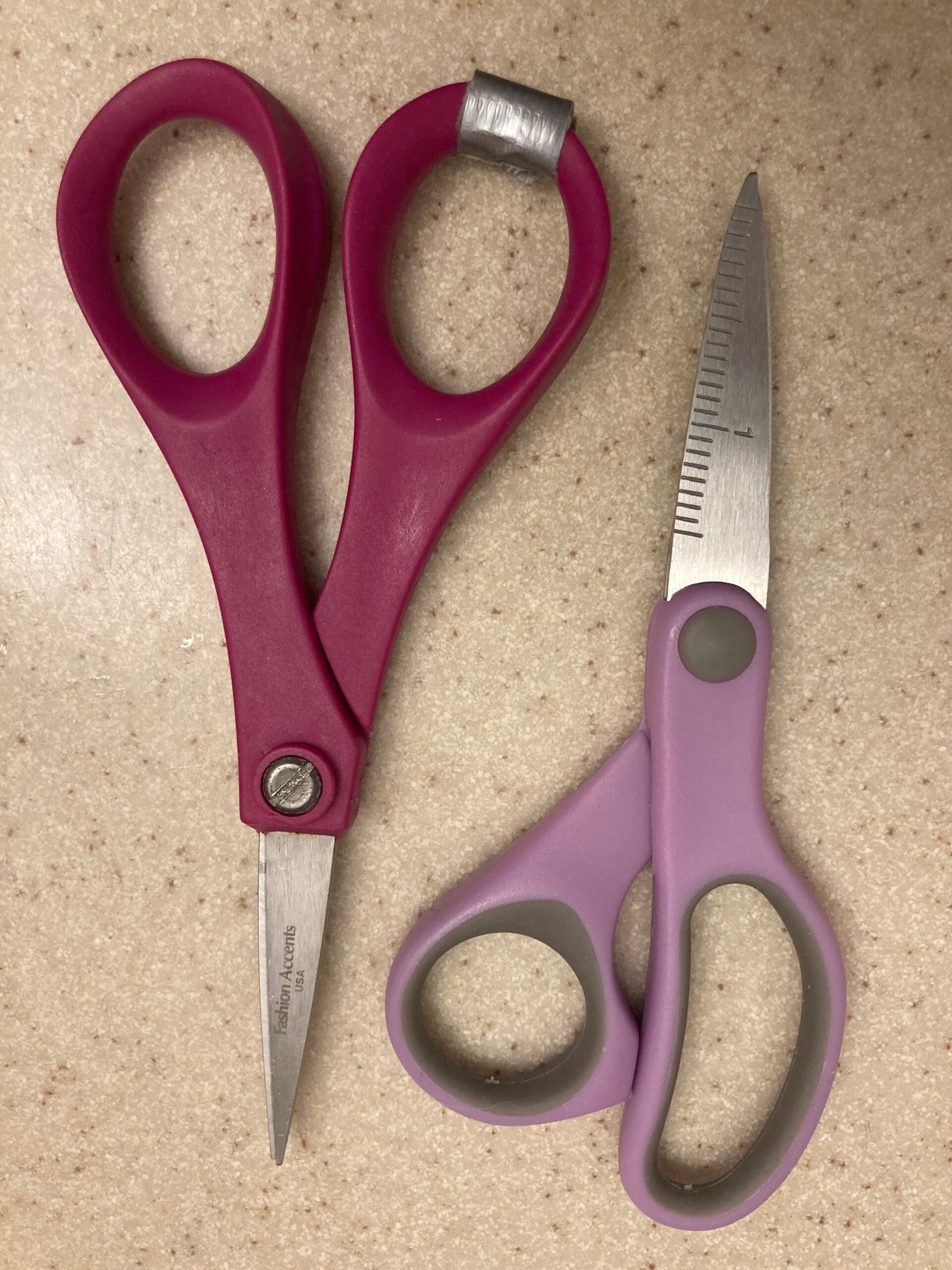
EXAMPLE 3: THE SCISSORS
I actually loved the pair of scissors on the left. They were just the right size plus nice and sharp (Note: "Don't keep dull things"). I loved them so much that I kept them even after the handle split and gave me a blood blister. After continuing to get pinched, I added Duck tape which helped protect me a bit. However, they were still broken underneath and, admittedly, the tape was unattractive. With some reluctance, I followed the feng shui principle to replace them. I found some similar scissors, albeit another brand, that are working just as well.
Bonus: I chose purple to supplement my Prosperity bagua![2]
One common feng shui strategy is to use certain colors in each bagua to enhance or strengthen that area, as well as "curing" problems. (See The Bathroom Sink as an example.)
EXAMPLE 4: THE CONTAINERS
There are some Ikea things that I love and use frequently (see The Hangers). Not sure if it still exists, but a while back I purchased a huge set of assorted sized plastic food containers. Over time, a few of them broke after being dropped. Not wanting to let go, I kept using them despite there being a slight risk of injury or at least discomfort when encountering the jagged edges. I acknowledged the bad energy and health hazard here, so they went into the recycle bin.
Note: I'll be honest, it's hard to get rid of things that are still usable, but I'm dedicated to seeing how feng shui will improve my life. In other words, I don't want to let a broken container (for example) get in the way of my health, happiness, and prosperity!


WHAT NOT TO DO:
Keep really old things, especially in mass quantities.
THE PLANNERS
These suckers were pushed to the back of a file cabinet drawer… Twenty-five in total dating back to 1997 and weighing 16.4 pounds. Talk about holding on to the past! And three more were missing. Plus there was a booklet of old business cards. If you had asked how many I had kept, I would’ve guessed about 5-7 years, kind of like tax returns. I briefly thought about glancing through some but decided against it because: 1) I would probably end up reading for hours, and 2) Despite the good memories, there were bad ones during some really stressful times that I didn’t want to unearth. I kept the ones from the previous two years so I can look back at dates and events as needed. The rest went into file 13.


WHAT TO DO:
Pay attention to symbolism, meaning, and personal significance.


EXAMPLE 1: THE CORKBOARD (SLIPPING)
Notice how the corkboard was sliding down out of its holders. The board would slip, and I'd push it back up. I tried tightening the holder screws a few times, but ultimately it would sink again, which became an ongoing annoyance. A simple fix of putting a nail under it helped it stay in place. What a relief!
Consider possible symbolism: To me, "slipping" suggests, "I'm gonna lose it!" which is a reminder to manage my stress better. It could also mean a behavior I'm trying to change but keep repeating. Or it could represent a feeling of unsteadiness or vulnerability.
The words that describe what's happening are personal, so someone else might see it as the corkboard is "sinking," or "coming loose," or "dropping," or "out of place," "wrong," or "off," for example. You get to choose the words and to determine what they might mean for you.
EXAMPLES 2 and 3: THE RUG, THE SILVERWARE DRAWER
More things moving around that shouldn't...
These are examples of "quick fixes" (also see The Hinges). I placed some "grippy stuff" under the rug. The photo to the right shows the scrape marks and gap at the front of the silverware drawer each time it slid. I used a square plastic bottle at the back of it to prevent it from sliding when we open the drawer.
Bonus: The bottle is not viewable unless you pull the drawer all the way out. These are both kind of a feng shui + practical fix.


EXAMPLE 4: THE SHOE RACK (BLOCKED, TRIPPING)
Karen Rauch Carter[1] sent a video today (10/30/2025) with suggestions regarding the placement of shoes. She noted that our shoes can be symbolic of things like movement, direction, traction, what path we're on, etc. I took a look at our shoe rack, which is in the Career bagua.[2] (Side Note: I'm in the process of growing my business[4].) All of the shoes were pointed in the same direction, but they were facing the wall. That made me think of roadblocks, dead ends, "hitting the wall," being stuck, or going nowhere! Also, I had been putting my shoes on the floor near the rack and frequently tripped on them as I turned the corner. Oh, and M left her umbrella on the rack a few weeks ago (rainy days?). To better support my career aspirations, I put the umbrella in M's room, took the shoes off the rack, dusted it, and replaced them facing outward. I switched my tennis shoes to the top rack to help "speed up" my opportunities. I put my hazardously placed shoes back on the rack and will do so moving forward.
UPDATE JUNE 2026: I wonder if Karen[1] has written anything about overthinking in feng shui?? My career goals were not progressing as I had hoped. As I kept walking by my shoe rack, it struck me that perhaps the direction of my shoes could represent clients as "on their way out," "out the door," or "ready to leave." I put them back in their original position and thought of phrases such as "on their way in," "get comfortable" and "stay awhile." Here's hoping!

BEFORE

AFTER

"You might want to move these (back)."
NOTE: Per my understanding, making feng shui changes will never bring us harm or cause bad things to happen. Shortly after rearranging my shoe rack, I went around the (other) corner and caught my shin on the top edge (hard enough to bleed!). I immediately felt frightened and thought: "What if I sped things up too much?!" After reassessing, I returned to what I know and chalked it up to me not paying attention.
WHAT NOT TO DO:
Let this happen anywhere in or near your space.
THE GARAGE
Hazardous Waste (2022)
Intimidating Signs
Rusty, Broken, Dirty Things

Thankfully I got a voucher to drop off these items for appropriate processing.

To the donation pile!

All of this had to be tossed. The previous owner left it when we bought our house in 2006.

Random Stuff
Sharp things, rusty things, broken things, tons of old papers, two empty birdfeeders, a rocker (as in "off my?"), a deflated volleyball, spilled cat litter (not used!), more hazardous waste, dull saws, three sprinklers, a bike that has only been ridden a few times, empty planters, lava rocks, surplus cookware, a chair that I have planned to reupholster since approximately 1998, new unused shelving that has been there since we moved in (2006), a frayed electric cord ("worn out?"), two boxes of seashells, etc. Yikes! Obviously a garage is used to store things, but this helped me re-analyze what should stay or go.

For Fun
The back right corner represents the feng shui bagua[2] called Relationships & Love. I cleared out the unused sharp and mystery items, plus I added a sign to reflect what I planned to create with law of attraction[4] (ex: finding a partner). But then I realized that the single, unused bike, lone ladder, and unused pots & pans may not be giving off the right vibe. Nothing's cooking in my relationship corner?! Plus there are empty shelves?? I do have a pair of leaf blowers, though, so that's a win.
Still some work to do here. : )
WHAT TO DO:
Create more space.
EXAMPLE 1: THE FRONT DOOR
Somewhere along the way, we discovered that magnets will stick to the inside of our front door. Yay! When I started to declutter and to use feng shui, I realized how crammed and chaotic the door looked. It felt a bit stressful to look at even though I had hand-picked each item. You might notice the little green post-it note in the window that reads, "Space = Opportunity." Ha! That's directly from Karen Rauch Carter,[1] and it's awesome advice when you actually use it. I gradually reduced the objects to an amount that still provide positivity but allow room to breathe, so to speak. Each item has specific meaning to me and was placed with deliberate intention to support what I want to maintain and to manifest[4].
Here are some things I removed and why:
- Black magnets (21 total + 15 more on the refrigerator) that seemed too numerous and out of balance
- Positive and cute magnets that I "liked all right" but wasn't attached to, also a few with some negative vibes
- Some artwork by M... I kept a few that I loved and that had sentimental value
- A gift card with a zero balance (hey, it had a happy bumblebee on it!) and it seemed like an anti-wealth symbol
- An old birthday card that I liked less as time went on, and it was starting to fade
- A few sticky notes that were flopped over even after being reinforced with Scotch tape
- Two dog bone-shaped dry erasers that I never liked (they were just convenient)
- Affirmation calendar pages that I no longer resonated with or that were bent or torn
- A temperature/humidity gauge that I appreciated but found ugly (also the magnet fell off and hot glue didn't fix it)
- Pictures of M when she was younger (not recommended per Karen as they symbolically keep M in a childlike state*)
*I did keep one child picture of M as an exception. I figure if she refuses to grow up all the way, I can remove it then. ; )
Consider the cumulative "energetic signature" of all the negative things!
See related examples in What Not to Do: "Cram tons of things in/on to a cabinet, cupboard, closet, drawer, surface, etc." and in What to Do: "Pay attention to your reactions" and "Pay attention to symbolism, meaning, and personal significance."
December 2022

February 2023

September 2024

January 2026

EXAMPLE 2: THE BED
Karen Rauch Carter[1] is resolute about this rule: NOTHING UNDER THE BED. EVER.
Trusting in her wisdom, I decided to clear everything from underneath my bed, which consisted primarily of three underbed containers (two big and one small). At first, I felt a little defensive: "Hey, those containers are cool and easy to pull out when I need something. Plus one lid is blue which is my favorite color! Everything is in its place (aka stuffed into the container)." However, upon examining the contents, I better understood the concept. Pure chaos was probably seeping into my psyche while I slept. Not to mention most of the stuff was sitting there unused for years.
The examples here are one container from my room and one from M's. Sesame showed up to inspect things, as usual.


WHAT TO DO:
Pay attention to your reactions.
Our thoughts and feelings can tell us what changes to make in regards to our physical space. For example, if I walk into a room and see something that makes me feel hate, anxiety, sadness, or guilt, it would make sense to change, move, or remove it. Conversely, if I see something that makes me feel love, comfort, happiness, or peace of mind, it would make sense to enhance it or leave it alone. The following are some examples of using thoughts and feelings as a guide.
EXAMPLE 1: THE CANVAS
This canvas is hanging in my Prosperity bagua,[2] and originally (2022) it was white and black. A year or two later, I decided to add the red dots to make it more interesting and to “activate” positive energy. This year (2025) I added MORE dots because more is always better, right? But then after walking in and out of the room a few times, I realized the canvas looked like it had a rash. And the effect was doubled due to it being reflected in our large vanity mirror. This really irritated me (just like a rash would!), so I removed the extra dots. I knew it was a good decision because I immediately felt calmer.


EXAMPLE 2: THE BOX
Whenever I saw the boxes (previously) stacked in my back room closet, I noticed one that looked like it was molding, especially in low light. It grossed me out! Upon closer inspection, I realized it was just wear on the cardboard, and the box was a little beaten up. Since it was an older style box that was sturdier than the new ones I had bought, I thought: "Maybe I should keep it!" But if I thought, "Ew, I don't like that" every time I looked at it, that would create a negative vibe which I don't want in general or particularly in that spot (which happens to be in my Prosperity bagua).[2] To the recycle bin it went, and I transferred the contents to a brand new box.
Note: The rule about not keeping worn and damaged things also applies here.


WHAT TO DO:
Correct or eliminate things that contradict your desires, intentions, or general state of well-being.
EXAMPLE 1: THE QUARTERS
M made money after selling her baked goods and gave it to me as reimbursement for some online purchases. We put the quarters and cash into a little gift bag, and it sat on our dining room window ledge for a good month or more. I was waiting until I had time and energy to organize it all (it actually wasn't that hard once I did it). I also wanted to coordinate with M to let her see how coins are rolled. As I kept putting it off, I realized that letting money "sit" didn't match my vibrational request for improved finances. I wanted money to flow, not pause or stop! I got it all sorted and made a quick trip to the bank.


EXAMPLE 2: THE POTS
When using feng shui to help attract[4] a new relationship, I noticed that I had two empty pots sitting near the edge of my Relationships & Love bagua[2] (helpful color here = pink) which is right next to the Fame and Reputation bagua. The lonely little pots made me think of an Amazon box I saw that read, "Without you, I'm empty inside!" Other words came to mind, like void, absence, and un(ful)filled. I realized it would be difficult to be famous in the eyes of my new partner if he never showed up.
Although I liked the ceramic pot, it didn't have drain holes which caused root problems (!) due to water pooling on the bottom. So that one needed to go. I was able to create drain holes for the other pot and planted a new Christmas cactus. With it, I focused on an intention for new love, growth, and cheerfulness.
NOTE: Karen Rauch Carter[1] says not to focus too literally on the bagua boundaries, so I treated the pots as applying to two areas. Karen advises against having cactus plants in any bagua with the exception of Fame and Reputation. To me, a cactus symbolizes having healthy boundaries, so I think it applies to my relationships as well.
EXAMPLE 3: THE FRAME
During an office move, the glass frame displaying my professional license got cracked. I let it sit in an unsorted box of things for many months before I finally took it back out. In terms of (not) supporting my career intentions, the frame made me think of words like broken, damaged, ruined, and dangerous. Not to mention there was an implication that my career needed to be "fixed" or had been put on hold. Out it went!


EXAMPLE 4: THE LIGHTS
This one illustrates a contradiction in intention, an incongruency, and a possible barrier to what I hoped to manifest[4]. These cute ladybug solar lights were a gift from my sister (special!), and I put them near my front porch to symbolize finding a new partner. At some point, they both stopped working, and the stem broke on one of them. So, in the spirit of "I'll fix them," they got stuffed into a cabinet on top of my feng shui supply box (heh), and there they sat for at least a year until I threw them out. Some symbols: Not working, broken, lack of a stable base, "no leg to stand on," discarded, lost, "lights out," mismatched, etc. etc. No wonder I'm still single! Well, at that time anyway. ; )
EXAMPLE 5: THE SHAMROCKS
These poor little shamrocks are not only cute, but they have special meaning to me since they started out as clippings from one of my sister's plants. They seek the sun during the day and close up a bit at night. In this instance, I neglected them through lack of watering, so they became increasingly withered, droopy, tired, malnourished, and sick. They would have died if I didn't intervene in time! Thankfully they perked up again after getting some water, and they are still thriving (thus correcting the vibe).

Nearly Dead Shamrocks

Sleepy But Healthy Shamrocks
WHAT NOT TO DO:
Cram tons of things in/on to a cabinet, cupboard, closet, drawer, surface, etc.
EXAMPLE 1: THE CABINET
Let me list some of the contents:
Old hand mixer with rusty beaters, bag of "things to be fixed," my green feng shui supply box (ha), two broken flower dishes with sharp edges, several empty wood trays from old craft kits, the magnetic thermometer from the front door (magnet fell off), a huge bottle of mostly gone glue that was last used around 2019, an unopened package of index cards from several years ago that M didn't need, taped-up papers that belong elsewhere (such as file cabinet or recycle bin), a cookbook we borrowed and needed to give back, spare Sharpie markers (some were dried up), an electric kettle that I don't want taking up space on our tiny countertop, an old phone + boxes + charger, a cardboard box with old paint and other unused art supplies, random food coloring bottles, various stacks of newspaper for painting, two mini bubble bottles with missing sticks, and an overflowing plastic shoebox with batteries. The orange shirt protects my beloved glass snow globe I bought from Hudson's about 30 years ago, and the yellow cup is for spider and other insect rescue.
My intention is to point out all of the stagnant, chaotic, and otherwise negative energy that was going on in this cabinet, as well as it being completely packed. Like the shoe rack, the red cabinet falls in my Career bagua.[2] If space equals opportunity, then I'm in trouble! Currently (2025), it's still more full than I would like (small home), but it's more organized than before.
Before

After

EXAMPLE 2: THE REFRIGERATOR
I seem to have a thing for magnets (see The Front Door)... Hence, the front of the refrigerator. Words come to mind, like: Crammed, packed, chaotic, disorganized, and scattered. I'm sensing a pattern here! I decided to remove things I didn't really like, had no particular personal meaning, and had just been stuck up for no apparent reason. Now there's more room to breathe.


EXAMPLE 3: THE FILE CABINET DRAWER
I finally found the right time to clear the final drawer in my huge black file cabinet. Having glanced in it recently, I thought it contained just office supplies, a small stack of printouts, and mortgage documents. Surprise surprise, in the back were a ton of old day planners that I didn’t realize were still in the house (see The Planners).
I paired down the printouts and decided to keep the rest since they have special meaning related to my now-deceased grandpa. Those went into the one banker box that contains keepsakes. I also weaned out some unnecessary mortgage papers, pitched the 25 expired planners (yes, you read that right), and kept the office supplies. Now the drawer has some space in front, back, and on top. Space = opportunity. I think Karen would approve!
BEFORE
AFTER


Sidebar: I've been moving these metal and plastic pieces from drawer to drawer since I bought the file cabinet. They've never been used, and I’m not even sure what some of them are for. I decided to pitch them but hesitated when I saw the two metal rods. "I could put them in THE GARAGE!" Why would I need metal rods, you ask? Beats me, although I had a brief thought about staking up plants. Am I getting more plants? No. Besides, the rods would be too long and looked ugly. “You can buy some rods or stakes if you need them, Lexi.” (True) Out they went.


WHAT TO DO:
Discard, donate, recycle, or repair items that are faded, worn, chipped, peeling, etc.
EXAMPLE 1: THE SUNCATCHER
This simple example is here for fun as well as illustrating a point about symbolism and getting rid of things that don't serve us. I painted a suncatcher who-knows-how-many years ago and had given it meaning in terms of finding a new partner (e.g., hope, dreams, happy endings). As time went on, I noticed that it was chipping, and it looked quite dried out. My dreams were supposed to be coming true, not slowly fading away! Or maybe it meant "Hurry up because we're both getting older," who knows. I probably could have repainted it but opted to throw it out. My intentions here demonstrate using Law of Attraction[4] as well as feng shui.


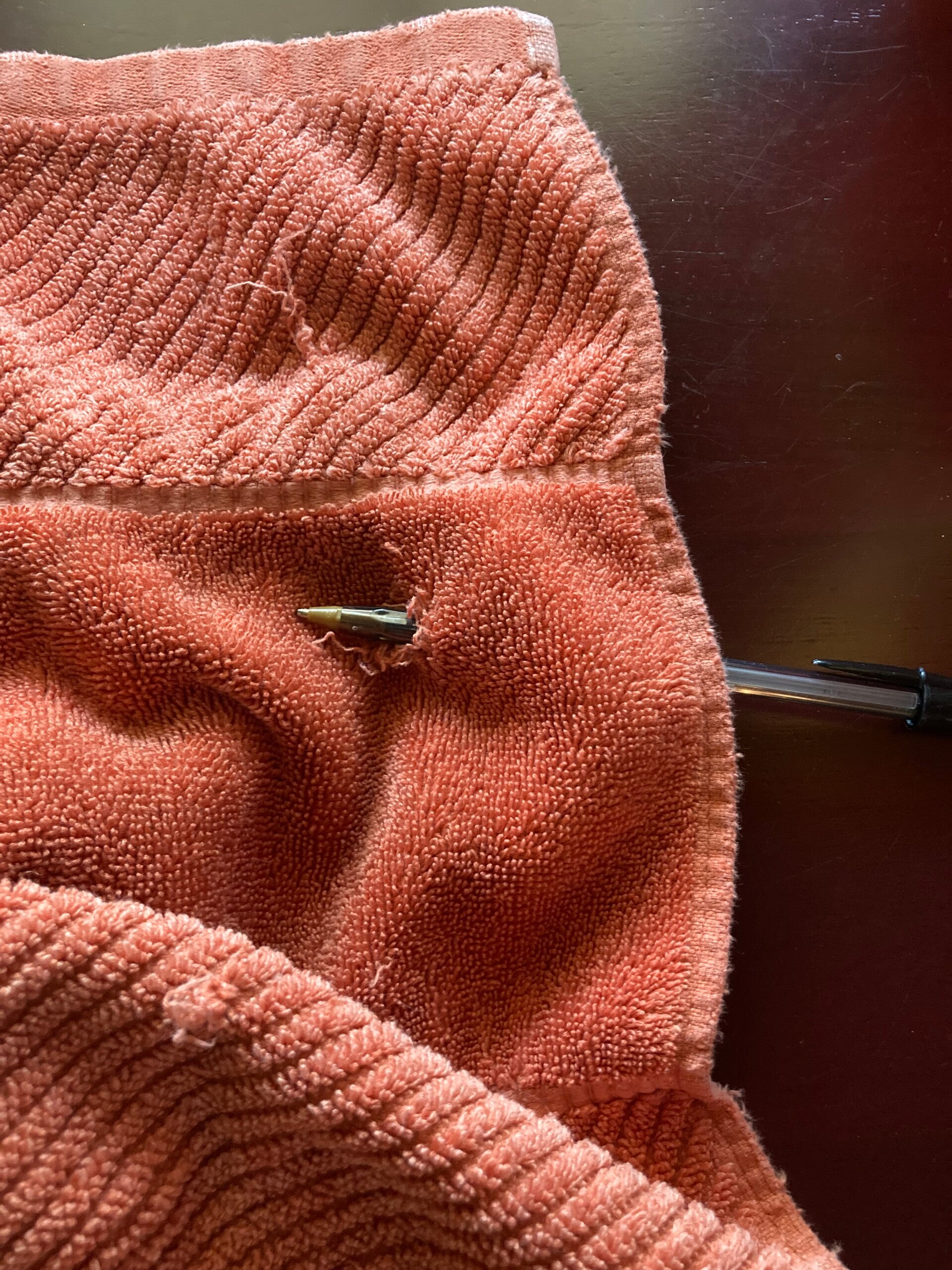
EXAMPLE 2: THE HAND TOWEL
This really old towel had sentimental value aside from me liking the brand, design, and color. However, I had to admit it was faded and worn. Notice the pen showing a hole plus frayed areas and a few loose threads that I could have trimmed, although they might have unraveled more. I couldn't help but notice the negative symbolism of "coming apart at the seams." I imagine this did not bode well for my mental health, as well as taking up space that a nice new towel could occupy. I lovingly let this go.
EXAMPLE 1: THE CHRISTMAS ORNAMENTS
This year (2026), I decided to go through my Christmas ornaments and keep only the ones I solidly like, really like, and love… particularly those with sentimental value. I have been storing and carting around many of these for years; some date back to when I was in high school. I’m 50 now, so you do the math!
In sorting them, I considered the following:
Some had negative associations depending on when I got them, who gave them to me, or whom I was with when I acquired them (sorry, random people!). Also certain symbols reminded me of bad memories. Others seemed plain, ugly, or incongruent. Now that I’m typing this, I’m thinking, “Why the heck do I keep putting these things on my otherwise happy and beautiful tree??”
However, after the process of what-I-thought-would-be-elimination, we ended up keeping all but about 10 ornaments because M decided to keep most of the rejects (ha ha). So it wasn't quite the downsizing I was hoping for. This is a great example of having other people in the house who enter into the equation of our decluttering and feng shui-ing.
Here are a few of my favorites and why:
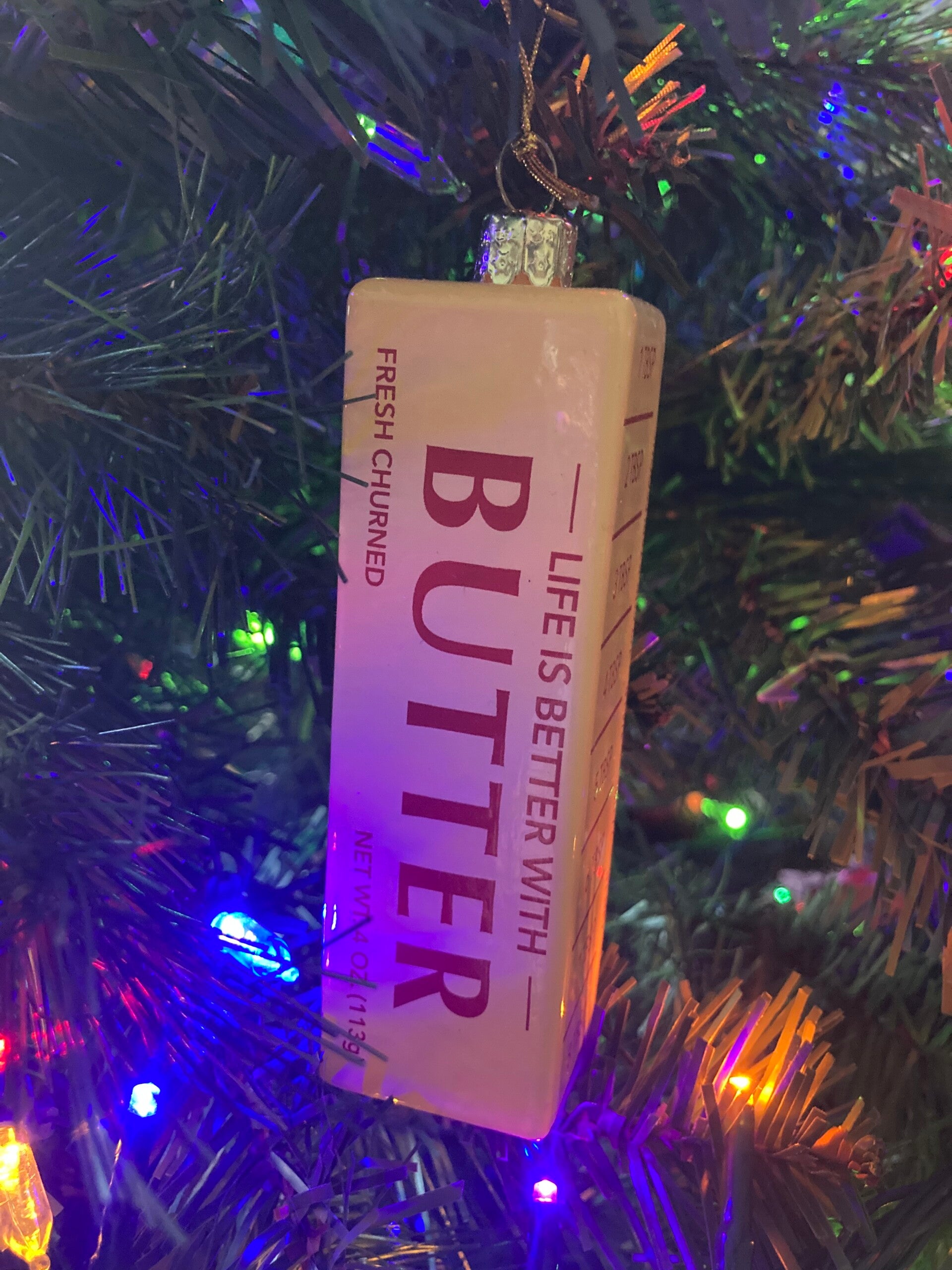
Reminds me of M and her love of baking.
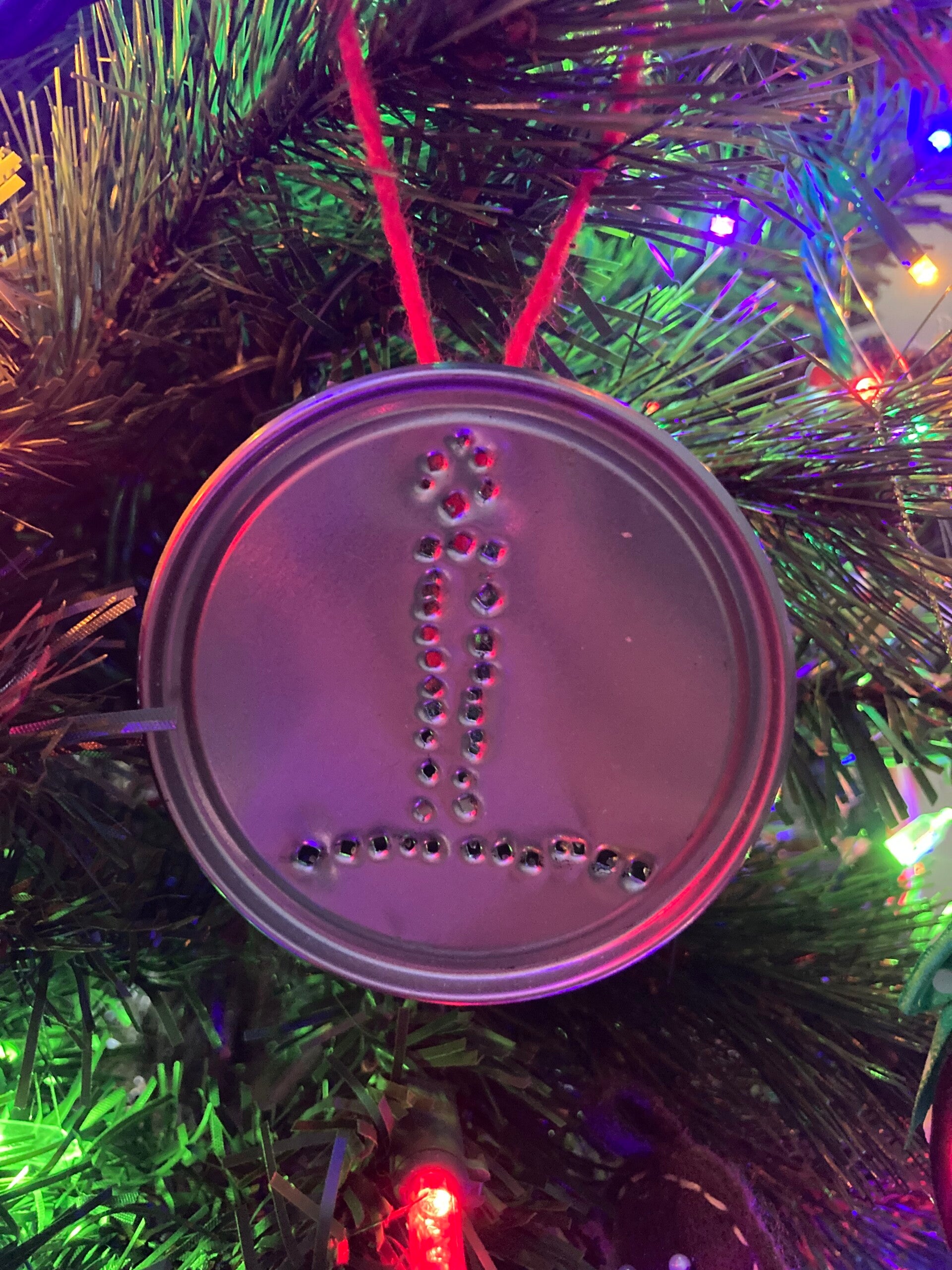
Made by my little sister when she was in 3rd grade.

Symbolic of my mom who also loves horses.

I heart Trader Joe's!
EXAMPLE 2: THE HALLOWEEN CROW
This little crow (raven??) was a gift from a relative. He's pretty cute, but for some reason I didn't like him much. (Wait, now I'm doubting my choice, heh!). Although a gift, it didn't have much sentimental value. Did I also mention his hat had separated from his head, and stuffing was coming out? I decided to repair the hat with hot glue (which worked), and I donated him. I liked the idea of someone else seeing him and being excited to take him home.
*Consider the literal and figurative meaning of "coming unglued!" See The Cork Board.


QUICK TIP: Our language can provide clues about how we make choices to keep or not keep things. For example, when I hear myself say, “I don’t hate it…” or “I don’t NOT like it…” or “It's okay,” I’m probably talking myself into keeping something that is really a “no.”
WHAT NOT TO DO:
Keep things that confuse you as to why they exist or remain in your space.
THE ROCKS
Why was this basket of rocks under my dresser, you ask? Beats me! Why are you keeping these random and visually unappealing rocks? "Because I might want or need them someday??" Not likely. There was a pretty Petoskey stone, but other than that, all of the rocks were ordinary. Sesame agreed. I think they may have been found on nature walks over the years. It's hard to be sentimental about things that have no memories associated with them. Also, I like the purple bag, but it has a negative vibe due to who gave it to me (sorry, unnamed person!). I put the rocks back outside, donated the bag to M, and gave away the Petoskey. I wish I had weighed the basket to see how many more pounds of stuff I had sitting around (See The Weight of Things below.) Oh, and by the way, I love love love the basket, so it got relocated to a place where it could serve a better purpose.


WHAT NOT TO DO:
Store things in a way that makes them hard to see and get to.
EXAMPLE 1: THE COFFEE TABLE
Having cleaned out and reorganized our coffee table drawer a year or more ago, I noticed that it had fallen into disarray again. My intention is to normalize the fact that our organizing can break down. Rather than beat ourselves up for it, we can redo it when time and energy allow.
My process was: Remove items that don’t belong; put those items in their proper place; throw away or recycle anything that needs it; and arrange the contents in an orderly fashion with the goal of having some clear spaces (because again, space = opportunity). For items that didn’t yet have a proper place, I decided where it would make sense for them to go versus randomly moving them to another drawer, container, bag, etc. Reducing the contents of the drawer stayed true to the decluttering and feng shui recommendation to avoid cramming things into a space, which then creates a need to go over, around, or through other things to get to what we need. Not to mention it made the drawer difficult to open and shut (ex: symbols of being “blocked” or “stuck”).
For additional examples of quick fixes plus symbolism, see The Front Door, The Bed, The Cabinet, The Refigerator, and the Front Door.
BEFORE
AFTER


EXAMPLE 2: THE HANGING SUPPLIES
I had a foggy-looking gallon-size ziplock bag (stuffed with equally foggy smaller bags) of what I refer to as "hanging supplies," which consisted of: Wall hangers, hooks, nails (a few were rusty), screws, push pins, command hooks, suction cups, wall anchors, dowels, velcro strips, bumpers, a spring, key rings, beaded chains, a few buttons, paper instructions on how to hang things, mini backpack click-straps, the missing piece of an incense holder, and some items I couldn't identify. After an epic sorting process that intrigued Sesame, I reduced what I wanted to keep to a shiny new quart-size bag with "like" items in their own mini container or snack-size bag. The command hooks also got their own new quart-size bag. Granted, the command hook bag doesn't close all the way, but the packaging prevents them from falling out, which workds for me. I still feel relieved every time I have to get some supplies because I know finding what I need will be easy and quick.
This feng shui rule is touched upon in other examples on this page showing spaces that are "crammed" with stuff (ex: The Cabinet, The Vases, The File Cabinet Drawer, The Coffee Table). Such overcrowding makes it hard to see what's there, and it forces us to move things around to get to the thing we want ... if it's even where we thought it was.

BEFORE

AFTER


WHAT TO DO:
Be kind, loving, and compassionate toward yourself despite dirt, messes, and mishaps.


EXAMPLE 1: THE DUST
I hesitated to include this example due to embarrassment... But then I realized that my message is to treat ourselves kindly without assigning blame, shame, or guilt. Regarding this dust, it got that way due to me being extremely tired and stressed, as well as being really good at ignoring things that I don't want to deal with. Would it have taken more than 5 minutes to clean? No, but at the time it felt like "too much" and "not a priority." So while the dust waited, I decided to add some hearts to symbolize love for myself even during times when I let things go. I also added a smiley face in a small display of prosperity symbols. The areas have since been cleaned and are happily accumulating more dust.

EXAMPLE 2: THE NAIL POLISH
Ugh, this one still haunts me. I had the bright idea to apply a tiny bit of nail polish in the Love and Relationship corner of a room with the intention to "fire up" romance in my life. (See The Bathroom Sink and The File Cabinet for use of the color red.) Unfortunately, I wasn't careful and knocked the bottle over. I tried a few different cleanup methods to no avail. I was really mad at myself afterward and used words like "stupid" and "idiot." When I calmed down, I reminded myself that I'm a human who makes mistakes, and I (kindly) reminded myself to be more mindful in the future. Fortunately, there's a chair over the stain right now. Despite the mishap, I kept my intention to have the red activate love for me. Maybe it means eternal love since it will never go away!
Side Note: That trim could use some sprucing up...

WHAT TO DO:
Add the color red to activate, redirect, or stop energy flow.
This is an example of a feng shui "cure."
FENG SHUI CURE
A feng shui cure is a specific remedy, object, or adjustment used to address and balance negative or stagnant energy, known as chi, in a space. Cures work by energizing, redirecting, or calming the chi to promote a more harmonious, supportive environment. [3]


EXAMPLE 1: THE BATHROOM SINK
I decided to clean out a slow drain in our bathroom sink, which is an example of something not working properly and being clogged in a literal and figurative sense. First, I cleared out the hair, soap scum, and other gunk before giving it a good scrub. Sesame inspected it to make sure I was thorough.
I then used red nail polish to paint the bottom of the stopper (heh) to symbolically prevent positive energy from "draining away" and leaving our house. In other words, I set an intention to go with my action. I also put red tape around the outgoing pipes under the sink for extra protection. Thanks again to Karen for these creative ideas!
QUICK TIP: A cure does not have to be in plain sight to work.
**See The Nail Polish above for a word of warning!
EXAMPLE 2: THE FILE CABINET
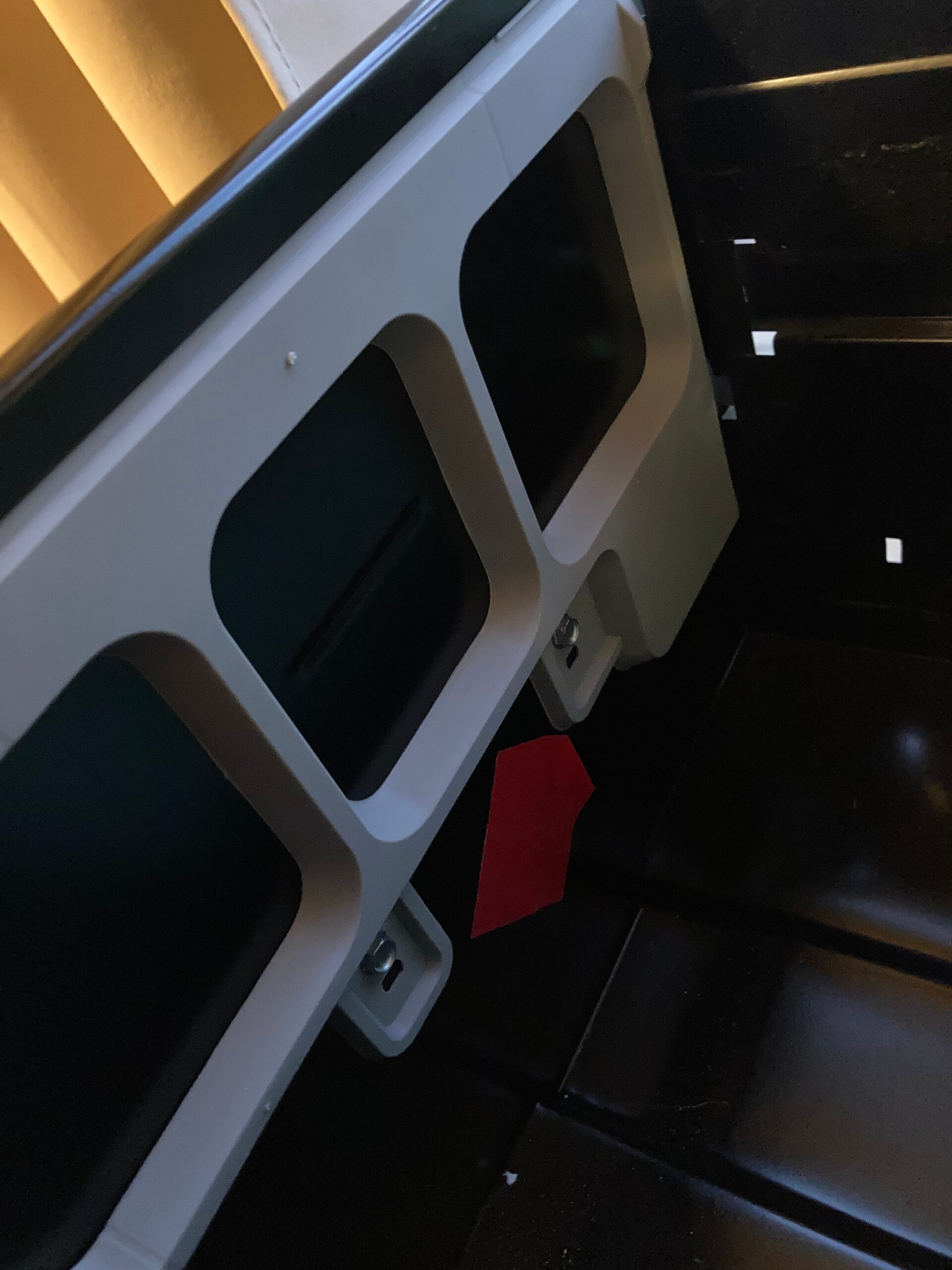
I have a tall, black, four-drawer file cabinet in my Fame and Reputation bagua.[2] Karen Rauch Carter[1] describes the color black as hazardous in this section; she adds that the color black symbolizes water which is also hazardous. Double whammy! I hope this is a cure she might suggest: I put a piece of red Duck Tape on the inside of each drawer with the intention of offsetting the black-water combo. I also realized I had two black surge protectors, a black printer, plus Sesame's black auto feeder in the room, so I put tape on those as well (also out of sight). Fame and reputation should come rolling in any time now!



WHAT TO DO:
Find quick and easy fixes.

THE HINGES
One suggestion from Karen Rauch Carter[1] is to make sure doors are not squeaky, creaky, or stuck. I used a small bottle of WD-40 on several hinges around the house that screeched every time they were used. A few quick sprays did the trick (with some paper towels for wiping away drips, it's a thin and oily liquid). Not only are the doors now quiet; they also open and close more smoothly.
For additional examples of quick fixes plus symbolism, see The Cork Board, The Silverware Drawer, The Rug, and the Shoe Rack.

Side Note: While fixing my hinges, I came across what was probably the previous owner's attempt at the same thing but using a strange black substance. It had always bugged me, but I didn't do anything about it (mostly because I assumed it would be hard to clean). Turns out it was easily removed with a few alcohol swabs.
THE WEIGHT OF THINGS
While continuing to declutter (a feng shui staple), I decided to sort through several boxes and baskets that I knew had unused and no-longer-wanted things in them. Much of it had been with me for years and had been moved from place to place. I eventually reduced most of the stuff to a small number of boxes that I'm proud to say were neatly stacked and labeled. For fun, I weighed the contents before I started sorting to see how many pounds I've been lugging around and holding onto.
TOTAL BEFORE SORTING: 167 lbs
Misc. Papers: 21.6 lbs

File Cabinet Drawer: 30.6 lbs

Cookbook Basket: 16.6 lbs

Piano Book Basket: 22.8 lbs

Books: 19.6 lbs and 18.2 lbs

CD's: 37.6 lbs
TOTAL AFTER SORTING: 26.8 lbs
Cookbook Basket: 6.4 lbs File Cabinet Drawer: 13.8 lbs Piano Basket: 6.6 lbs
I donated, recycled, or discarded nearly all of the items from the remaining three boxes, with the exception of a few keepsakes.
SESAME AND THE VERY LONG PAPER SORT
You may notice Sesame in some of the photos on this page... She provided frequent supervision and moral support!


HERE THERE BE MESSES
Sharing some examples for encouragement... Persistence pays!!


Sesame appears in 3 of these photos (click to enlarge). Two are obvious, but can you find the third? The answer appears after Resources below!


MOVE YOUR STUFF, CHANGE YOUR LIFE

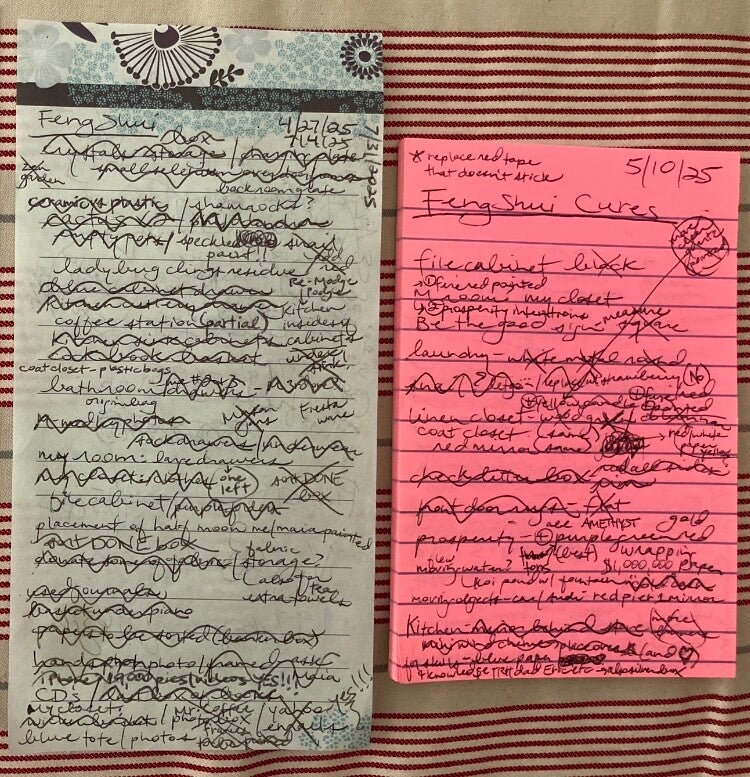
While going through the mass of stuff in my house, I came across some feng shui notes I had made in 2016 based on Karen Rauch Carter's book: "Move Your Stuff, Change Your Life," which I think was originally published in 2000. So back then I was at least considering putting these things into action! What's the first step? Set an intention to make positive changes.
Your own decluttering and feng shui efforts don't have to take a decade like mine have, and you don't have to overhaul every inch of your space.
Every little bit helps. : )
"Move Your Stuff, But Don't Overwhelm Yourself by Trying to Do Every Idea Known to Mankind."
RESOURCES
[1] I am so thankful to Karen Rauch Carter, professional feng shui consultant, healthy-lifestyle designer, educator, and best-selling author, whose teachings have helped me improve my life in amazing ways. Nearly 100% of my knowledge of basic feng shui principles and strategies is derived from Karen's work. I particularly love her recommendation to customize changes to best support the person or people involved, her stance of "leaving things alone" that are already working, and her suggestion to follow our own guidance if something feels off. Any mistakes in describing or implementing feng shui are mine alone.
Karen's methods, publications, and more can be viewed on her website at:
[2] Karen Rauch Carter explains baguas and enhancement tips here: karenrauchcarter.com/the-feng-shui-bagua-map
[3] Definition for "feng shui cure" was obtained online 10/12/2025 via Google internet search engine AI Overview.
[4] Regarding manifestation, I first listened to a recording of Esther Hicks over 20 years ago and immediately thought it was too weird for me. Upon revisiting Abraham-Hicks' teachings several years later, their information began to make more sense and to resonate with me. I recommend all of their work, including their Daily Law of Attraction Quotations (scroll down on the home page).
Abraham-Hicks' teachings, publications, workshops, and more can be viewed on their website at:
Answer: Sesame is in the 6th picture from the left hiding behind the birdseed bag (top right).